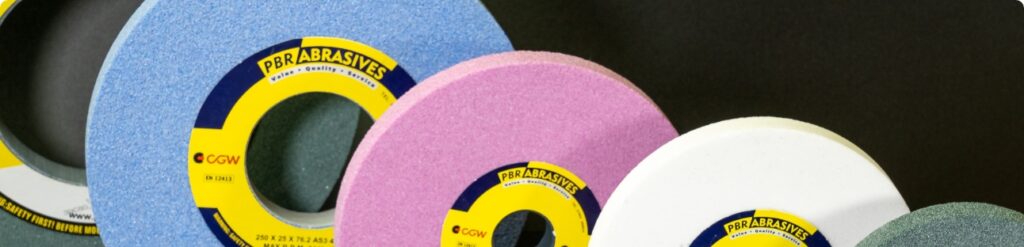
Choosing the correct grinding wheel involves more than selecting the right abrasive and grit size. The wheel grade is equally important because it affects cutting performance, wheel wear, heat generation and the quality of the finished component.
However, grinding wheel grade is often misunderstood. A “hard” grinding wheel does not necessarily contain a harder abrasive, and a “soft” wheel is not physically soft. The grade describes how strongly the bonding material holds the abrasive grains within the wheel.
Understanding this distinction will help you choose a wheel that cuts efficiently, avoids excessive heat and delivers the required finish.
What Is a Grinding Wheel Grade?
A grinding wheel consists of three main elements:
- Abrasive grains that remove material
- Bonding material that holds the grains together
- Pores or spaces that allow swarf to escape
The wheel grade indicates the strength with which the bond holds the abrasive grains.
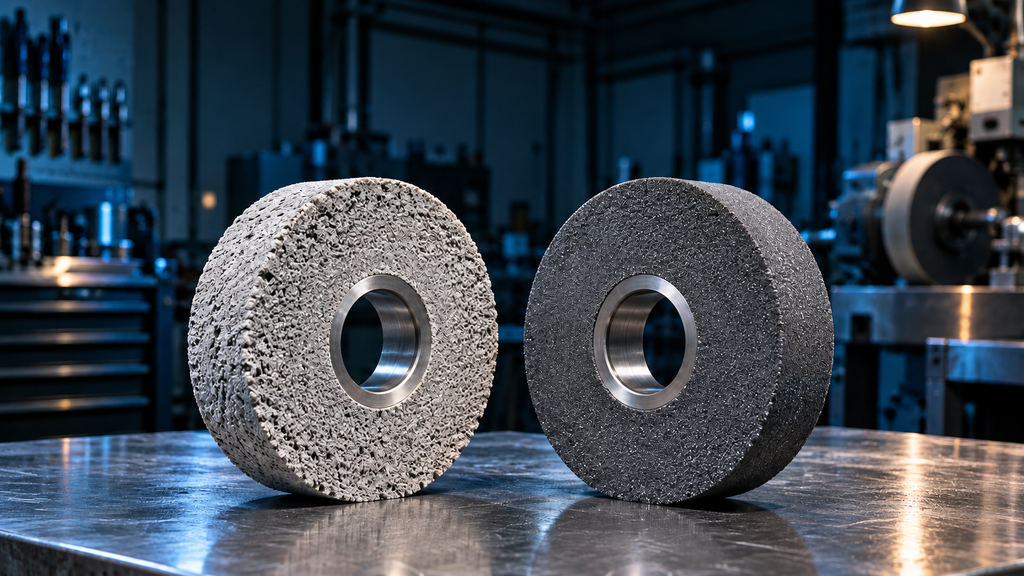
A soft-grade wheel releases its abrasive grains relatively easily. A hard-grade wheel holds them in place for longer.
Grinding wheel grades are commonly represented by letters:
- A to H: Soft grades
- I to P: Medium grades
- Q to Z: Hard grades
These ranges are general guides, and grading systems can vary between manufacturers. Always consult the manufacturer’s specification or speak to an abrasives specialist when selecting a wheel for a critical application.
What Is a Soft Grinding Wheel?
A soft grinding wheel has a bond that releases abrasive grains more readily during use.
As an abrasive grain becomes dull, grinding pressure causes it to break away from the wheel. This exposes a new, sharp grain underneath, allowing the wheel to continue cutting effectively.
This process is often referred to as self-sharpening.
Soft-grade wheels are generally suitable for:
- Grinding hardened steels
- Materials that quickly dull abrasive grains
- Large areas of contact
- Heavy stock removal
- Applications where heat generation must be controlled
- Operations where grinding burn is a concern
Because the grains are released more quickly, a soft wheel will usually wear faster than a hard wheel. However, this does not necessarily make it less economical. A freely cutting wheel can reduce cycle times, prevent rejected components and place less strain on the grinding machine.
What Is a Hard Grinding Wheel?
A hard grinding wheel has a stronger bond that retains the abrasive grains for longer.
Hard-grade wheels generally wear more slowly and maintain their shape well. This makes them useful where dimensional accuracy, edge retention or a long wheel life is required.
Hard-grade wheels are commonly used for:
- Grinding softer materials
- Small or narrow contact areas
- Light grinding operations
- Applications requiring good form retention
- Operations where wheel wear must be minimised
- Machines with lower grinding pressure
A wheel that is too hard for the application may hold worn or blunt grains instead of releasing them. The wheel can then begin to rub against the workpiece rather than cutting it efficiently.
This can cause excessive heat, glazing, vibration, poor surface finish and grinding burn.
The Difference Between Wheel Grade and Abrasive Hardness
Wheel grade and abrasive hardness are not the same thing.
Abrasive hardness refers to the cutting grain itself. Common grinding-wheel abrasives include:
- Aluminium oxide
- Silicon carbide
- Ceramic alumina
- Diamond
- Cubic boron nitride, or CBN
Wheel grade describes the strength of the bond holding those grains in the wheel.
It is therefore possible to manufacture both soft-grade and hard-grade grinding wheels using the same abrasive material. The abrasive grains may be identical, while the bond strength and wheel behaviour are different.
The Difference Between Wheel Grade and Grit Size
Wheel grade is also different from grit size.
Grit size describes the size of the abrasive particles:
- Coarse grits remove material quickly
- Medium grits balance stock removal and finish
- Fine grits produce smoother finishes
Grade describes how securely those abrasive particles are held.
For example, two wheels may both use 46-grit aluminium oxide. One may have a soft grade that releases dull grains quickly, while the other may have a hard grade designed to retain its grains for longer.
The correct grinding wheel must combine a suitable abrasive, grit size, grade, structure and bond type.
Should You Use a Soft or Hard Wheel for Hard Materials?
One of the most important rules in grinding-wheel selection is:
Hard materials generally require a softer-grade wheel, while softer materials generally require a harder-grade wheel.
This can initially appear contradictory, but it relates to how quickly the abrasive grains become dull.
Hard materials tend to blunt the cutting grains more quickly. A softer bond allows these worn grains to break away, continually exposing fresh cutting edges.
Softer materials do not usually dull the abrasive as quickly. A harder bond can therefore retain the grains for longer without negatively affecting the cutting action.
This is a useful starting point, but the final selection must also consider the contact area, machine power, wheel speed, feed rate, coolant and required finish.
Factors That Affect Grinding Wheel Grade Selection
Workpiece Material
The hardness, tensile strength and composition of the material all influence the most suitable wheel grade.
Hardened tool steels and other difficult-to-grind materials often require softer grades. Softer steels and some more easily machined materials may permit a harder grade.
The material can also influence the most appropriate abrasive type, so wheel grade should never be selected in isolation.
Area of Contact
The size of the contact area between the wheel and workpiece has a significant effect on grinding pressure and heat.
A large contact area generally requires a softer-grade wheel. This helps the wheel release worn grains and remain free-cutting.
A small or narrow contact area may allow a harder grade because the individual grains experience greater pressure and can cut effectively without being released as quickly.
Material Removal Rate
Heavy stock removal creates more grinding force and heat. A softer-grade wheel is often preferred because it continuously exposes fresh abrasive grains.
For light grinding or finishing operations, a harder grade may provide better wheel life and dimensional stability.
Wheel Speed
Changing the operating speed can alter how a grinding wheel behaves.
At higher operating speeds, a wheel may behave as though it has a harder grade because each abrasive grain penetrates the workpiece less deeply. Reducing the speed can make the wheel behave more softly.
The wheel’s maximum permitted operating speed must never be exceeded.
Feed Rate and Grinding Pressure
Higher feed rates and deeper cuts increase the force applied to the abrasive grains. This can cause grains to release more quickly, making the wheel behave more softly.
Light feeds and low grinding pressure may make the wheel behave harder. If there is insufficient pressure to release dull grains, the wheel may glaze.
Required Accuracy
A harder-grade wheel generally retains its profile more effectively, which can be beneficial for precision grinding and applications involving detailed wheel forms.
However, choosing a grade that is too hard simply to reduce wheel wear can create excessive heat and damage the workpiece.
The objective is to select the hardest grade that still cuts freely without glazing or burning.
Coolant
Coolant affects grinding temperature, chip removal and wheel performance. A wheel may behave differently during wet grinding than it does during dry grinding.
The coolant type, concentration, flow rate and position should all be considered when finalising a grinding-wheel specification.
How to Read the Grade on a Grinding Wheel
The grade normally appears as a letter within the wheel specification.
For example:
A 46 K 7 V
This may indicate:
- A: Aluminium oxide abrasive
- 46: Grit size
- K: Wheel grade
- 7: Wheel structure
- V: Vitrified bond
In this example, the letter K identifies the wheel grade.
Grinding-wheel marking systems can contain additional manufacturer-specific codes, so the complete specification should always be checked rather than relying on one letter alone.
What Happens If the Wheel Is Too Hard?
A grinding wheel that is too hard for the application may fail to release worn abrasive grains.
Common signs include:
- A shiny or glazed wheel surface
- Excessive grinding heat
- Burning or discolouration of the workpiece
- Increased grinding forces
- Vibration or chatter
- Poor material removal
- Loss of surface quality
- Cracking or heat damage to the component
Dressing the wheel may temporarily restore its cutting action, but repeated glazing usually indicates that the specification or operating conditions need to be reviewed.
What Happens If the Wheel Is Too Soft?
A wheel that is too soft releases useful abrasive grains before they have completed their cutting life.
Common signs include:
- Rapid wheel wear
- Frequent dressing requirements
- Difficulty maintaining the wheel profile
- Poor dimensional accuracy
- Excessive abrasive waste
- Reduced wheel life
- An unusually high level of wheel debris
Moving to a slightly harder grade may improve wheel life, provided the wheel continues to cut freely and does not generate excessive heat.
Soft vs Hard Grinding Wheels: Quick Comparison
| Soft-grade wheel | Hard-grade wheel |
| Releases abrasive grains more easily | Retains abrasive grains for longer |
| Continuously exposes fresh cutting edges | Provides longer grain retention |
| Typically used on harder materials | Typically used on softer materials |
| Suitable for larger contact areas | Suitable for smaller contact areas |
| Helps reduce glazing and grinding heat | Offers improved form retention |
| Usually wears more quickly | Usually provides longer wheel life |
| Useful for heavy stock removal | Useful for lighter or precision operations |
How to Choose the Correct Grinding Wheel Grade
When selecting a wheel grade, consider:
- The material being ground
- The hardness of the workpiece
- The amount of material being removed
- The size of the contact area
- The wheel and workpiece speeds
- The machine’s power and rigidity
- Whether coolant is being used
- The required surface finish
- The required dimensional accuracy
- The wheel’s expected life and dressing frequency
If an existing wheel is glazing, burning the component or cutting slowly, a softer grade may be required.
If the wheel is wearing too quickly or losing its shape, a harder grade may be more appropriate.
Only change one part of the specification or grinding process at a time. This makes it easier to identify which adjustment has improved or reduced performance.
Grinding Wheel Safety
Always ensure that the grinding wheel is suitable for the machine and application.
Before use:
- Check the wheel for visible damage
- Confirm that its dimensions and bore are correct
- Ensure the wheel’s maximum operating speed is not exceeded
- Use the correct mounting flanges
- Fit and adjust the machine guards correctly
- Carry out the appropriate inspection or ring test where applicable
- Wear the required personal protective equipment
- Follow the wheel and machine manufacturers’ instructions
Never use a damaged wheel or force a wheel onto a spindle.
Frequently Asked Questions
Does a hard grinding wheel contain harder abrasive?
Not necessarily. Wheel grade describes how strongly the bond holds the abrasive grains. It does not describe the hardness of the abrasive itself.
Why are soft wheels used on hard materials?
Hard materials dull abrasive grains more quickly. A soft bond releases these worn grains and exposes new, sharp cutting edges.
Why are hard wheels used on soft materials?
Softer materials generally do not dull the abrasive as quickly. A harder bond can retain the cutting grains for longer, improving wheel life.
How can I tell if a grinding wheel is too hard?
Glazing, slow cutting, increased grinding pressure, excessive heat and workpiece burn can all indicate that the wheel is too hard for the application.
How can I tell if a grinding wheel is too soft?
Rapid wheel wear, loss of profile, frequent dressing and difficulty maintaining dimensional accuracy may indicate that the wheel is too soft.
Does a higher grade letter always mean a harder wheel?
Within a manufacturer’s grading system, later letters normally indicate a harder grade. However, grades from different manufacturers or wheel ranges may not perform identically.
Find the Right Grinding Wheel for Your Application
Selecting the correct grinding wheel grade can improve cutting performance, component quality, wheel life and overall production efficiency.
The best-performing wheel is not automatically the hardest or longest-lasting option. It is the wheel that releases abrasive grains at the correct rate for the material, machine and grinding conditions.
PBR Abrasives supplies grinding wheels for a wide range of precision, production and general engineering applications. If you are unsure whether your application requires a soft, medium or hard grade, contact our team with details of your material, machine, wheel size and required finish. We can help you identify the most suitable specification.